
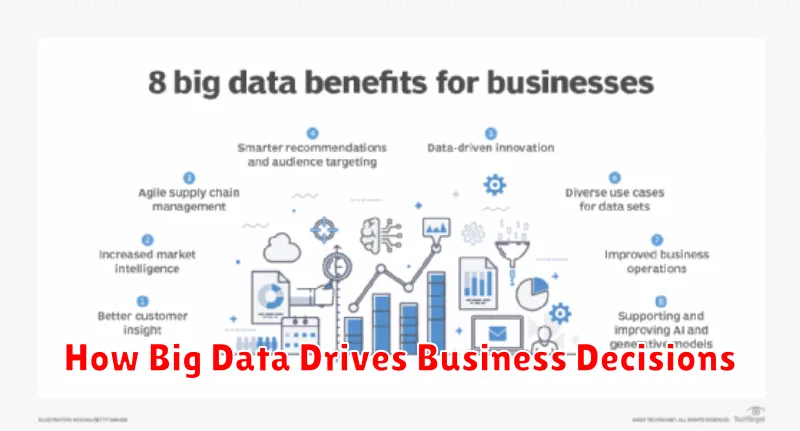
In today’s data-driven world, businesses are constantly seeking ways to gain a competitive edge. Big data has emerged as a powerful tool that is transforming the way organizations operate and make decisions. Understanding how to leverage the insights derived from big data is crucial for success in the modern business landscape. This article explores the profound impact of big data on business decisions, examining how its analysis and interpretation can lead to improved strategies, optimized operations, and increased profitability.
From predicting customer behavior and personalizing marketing campaigns to streamlining supply chains and mitigating risks, the applications of big data are vast and far-reaching. By harnessing the power of big data analytics, businesses can gain a deeper understanding of their customers, markets, and internal processes. This article delves into the various ways big data is driving business decisions, providing practical examples and insights into its transformative potential. We will examine how organizations are using big data to achieve business objectives and gain a competitive advantage in their respective industries. Discover how big data is revolutionizing business decisions and shaping the future of commerce.
Defining Big Data
Big data is a term that describes the large, complex data sets that are now being generated by businesses and other organizations. These data sets are so large and complex that traditional data processing applications are inadequate to deal with them.
Three key characteristics define big data. These are commonly referred to as the “3 Vs”: volume, velocity, and variety.
Volume refers to the sheer amount of data. We are now producing data at an unprecedented rate, from social media interactions to sensor data from the Internet of Things.
Velocity describes the speed at which data is generated and processed. Real-time data streams require immediate analysis, making fast processing crucial.
Variety signifies the different forms of data. This can include structured data like database tables, semi-structured data like JSON files, and unstructured data like text documents and multimedia files.
Why Businesses Rely on Data
In today’s competitive landscape, data has become an invaluable asset for businesses of all sizes. Data-driven decision-making empowers organizations to operate more efficiently, understand their customers better, and gain a competitive edge.
Improved Efficiency and Productivity: By analyzing operational data, businesses can identify bottlenecks, streamline processes, and optimize resource allocation. This leads to increased productivity and reduced operational costs.
Enhanced Customer Understanding: Data provides insights into customer behavior, preferences, and needs. This understanding allows businesses to personalize marketing campaigns, improve customer service, and develop products and services that resonate with their target audience.
Effective Risk Management: Analyzing historical data and market trends helps businesses identify potential risks and make informed decisions to mitigate them. This proactive approach minimizes financial losses and protects the business’s reputation.
Data-Backed Innovation: By analyzing market trends and customer feedback, businesses can identify opportunities for innovation and develop new products and services that meet evolving customer demands. This fosters growth and ensures long-term success.
Sources of Big Data
Big data originates from a multitude of sources, encompassing both digital and physical realms. Understanding these sources is crucial for effectively leveraging big data’s potential.
Digital Sources
A significant portion of big data comes from digital platforms. Social media platforms generate massive amounts of data through user interactions, posts, and shared content. Machine-generated data from sensors, industrial equipment, and Internet of Things (IoT) devices provide valuable insights into operations and performance. Transactional data from online purchases, financial transactions, and online activity contribute to a deeper understanding of customer behavior and market trends.
Physical Sources
The physical world also contributes substantially to big data. Genomic data provides insights into human health and disease. Data collected from scientific experiments and research contributes to advancements in various fields. Weather sensors and satellites collect environmental data, aiding in climate modeling and disaster prediction.
Data-Driven Decision Examples
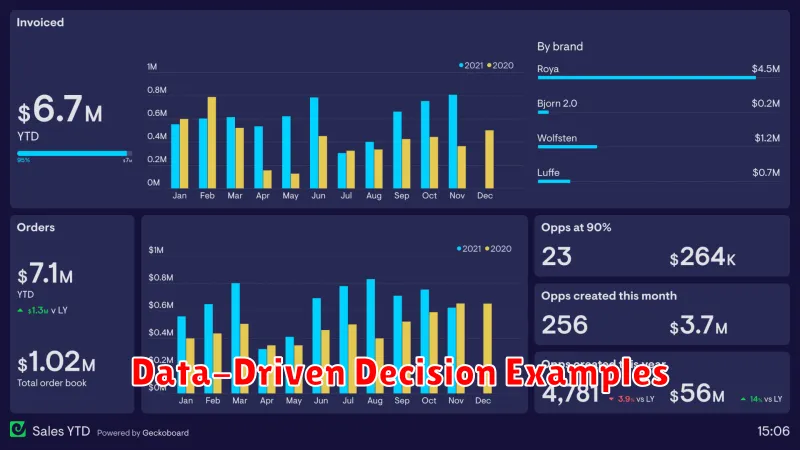
Data-driven decision making is becoming increasingly crucial across various industries. Let’s explore some practical examples showcasing its impact.
Retail & E-commerce
Retailers leverage data on customer purchase history, browsing behavior, and demographics to personalize recommendations and optimize pricing strategies. Analyzing sales data also helps in inventory management, reducing waste and ensuring product availability.
Marketing & Sales
Marketing campaigns benefit significantly from data analysis. By understanding customer segments and their preferences, businesses can target specific demographics with tailored messages. Analyzing website traffic and lead generation data allows for optimized ad spending and improved conversion rates.
Predictive Analytics in Practice
Predictive analytics moves beyond simply describing what happened to anticipating future outcomes. It leverages historical data, statistical algorithms, and machine learning techniques to identify patterns and predict future trends.
Businesses across various sectors utilize predictive analytics to gain a competitive edge. For example, retailers use it to forecast demand, optimize inventory, and personalize customer offers. Financial institutions leverage these techniques to assess credit risk and detect fraudulent activities. In healthcare, predictive analytics can help identify patients at high risk of developing certain diseases, enabling proactive interventions.
Implementing predictive analytics involves several key steps: defining the business objective, gathering and preparing relevant data, building predictive models, and deploying and monitoring those models. Continuous evaluation and refinement of the models are crucial for ensuring accuracy and relevance as new data becomes available.
Big Data Tools and Platforms
Effectively leveraging big data requires robust tools and platforms. These tools are designed to handle the volume, velocity, and variety inherent in big data. Choosing the right tools depends on the specific needs of the business and the types of insights being sought.
Several categories of tools exist, including those for data storage, data processing, and data analysis. Data storage solutions like Hadoop Distributed File System (HDFS) and cloud-based storage provide scalable repositories for massive datasets. Data processing tools like Apache Spark and Apache Flink enable efficient data manipulation and transformation. Finally, data analysis tools ranging from programming languages like Python and R to specialized business intelligence platforms empower users to extract meaningful insights.
Selecting the right combination of platforms and tools is crucial for successful big data initiatives. Organizations must consider factors such as scalability, cost, integration capabilities, and the skills of their data team.
Future Trends in Data-Driven Strategy
The future of data-driven strategy promises even more sophisticated applications of data analysis and interpretation. Real-time analytics will become increasingly crucial, enabling businesses to react instantly to changing market conditions and customer behavior.
Artificial intelligence (AI) and machine learning (ML) will play a larger role, automating data analysis, identifying complex patterns, and making predictions with increasing accuracy. This will enable more proactive and predictive decision-making.
Edge computing will gain traction, processing data closer to its source to reduce latency and improve efficiency, especially for applications like IoT devices and real-time analytics.
The importance of data security and privacy will continue to grow. Businesses will need to invest heavily in robust security measures and comply with evolving data privacy regulations to maintain customer trust and avoid costly breaches.
