
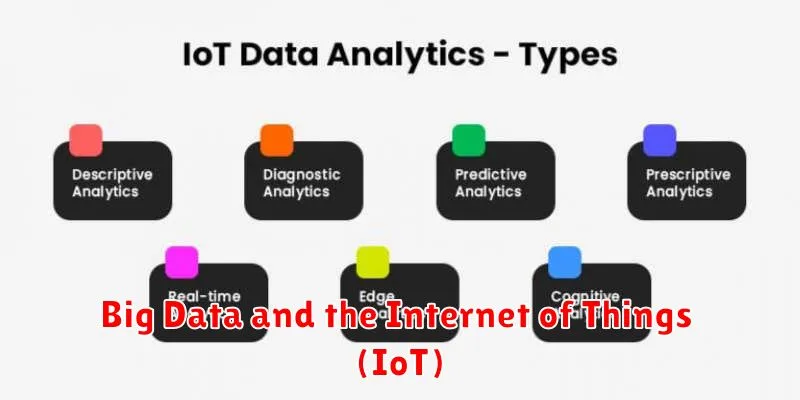
In today’s interconnected world, the convergence of Big Data and the Internet of Things (IoT) is revolutionizing industries and reshaping the way we live. The IoT generates massive volumes of data, creating unprecedented opportunities for businesses to gain valuable insights. This data, often referred to as Big Data, can be analyzed to optimize operations, enhance decision-making, and create innovative products and services. Understanding the relationship between Big Data and the IoT is crucial for organizations seeking to leverage the full potential of these transformative technologies.
This article delves into the synergy between Big Data and the IoT, exploring the challenges and opportunities presented by this powerful combination. We will examine how Big Data analytics can be applied to IoT data to unlock valuable insights. Furthermore, we will discuss the implications of Big Data and the IoT across various sectors, including healthcare, manufacturing, and transportation, highlighting the transformative impact of these technologies on business processes and societal advancements. By understanding the power of Big Data and the IoT, organizations can gain a competitive edge and drive innovation in the digital age.
How Big Data Powers IoT
The Internet of Things (IoT) generates massive amounts of data from interconnected devices. This data, in its raw form, isn’t particularly useful. Big data analytics provides the tools and techniques to process and interpret this data, transforming it into actionable insights.
Essentially, big data acts as the engine for IoT. It allows us to extract value from the constant stream of information flowing from sensors, wearables, and other connected devices. This process involves several key steps, including data ingestion, storage, processing, and analysis.
Data analysis reveals patterns, trends, and anomalies that would otherwise remain hidden. These insights can be used to optimize operations, improve efficiency, and develop new products and services.
Sensors and Real-Time Data
At the heart of the Internet of Things (IoT) lies the sensor. These devices are responsible for collecting data from the physical world, transforming real-world phenomena into digital information. This data can range from temperature and pressure readings to location and movement tracking.
A key characteristic of IoT data is its real-time nature. Real-time data refers to information that is delivered immediately after collection, with minimal latency. This immediacy allows for timely insights and actions based on current conditions. The ability to process and react to this data in real time is crucial for many IoT applications, such as monitoring critical infrastructure or managing smart home devices.
Different types of sensors exist for various applications. Some common examples include:
- Temperature sensors: Measure temperature.
- Pressure sensors: Measure pressure changes.
- Proximity sensors: Detect the presence of nearby objects.
- Accelerometers: Measure acceleration and motion.
Smart Cities and Homes
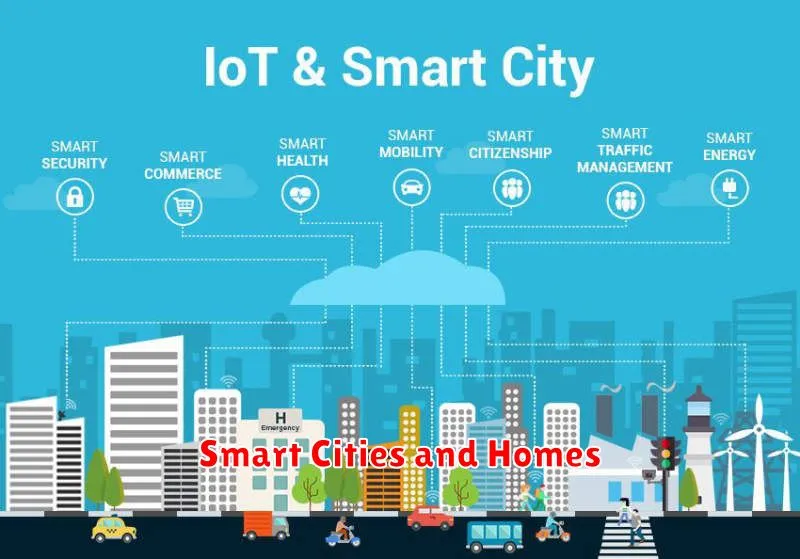
Big data and the Internet of Things (IoT) converge powerfully in the development of smart cities and homes. IoT devices, from traffic sensors to smart thermostats, generate massive amounts of data that, when analyzed, can optimize resource allocation and improve efficiency.
In smart cities, this translates to optimized traffic flow, reduced energy consumption, and improved public safety. Data from connected sensors allows city planners to make data-driven decisions regarding infrastructure and resource management.
Smart homes leverage IoT to enhance convenience, security, and energy efficiency. Connected appliances, lighting systems, and security systems can be monitored and controlled remotely, offering homeowners greater control and personalization.
Data Management Challenges
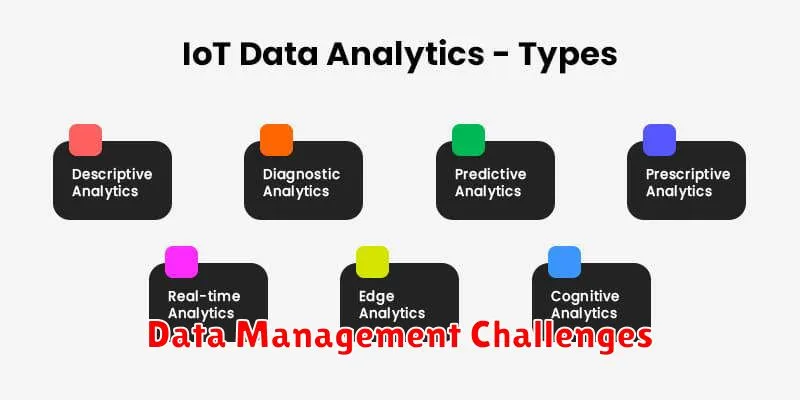
The convergence of Big Data and the Internet of Things (IoT) presents significant data management challenges. The sheer volume of data generated by connected devices can easily overwhelm traditional data storage and processing systems. Variety poses another hurdle, as IoT data comes in various formats, from structured sensor readings to unstructured video feeds.
Velocity, the speed at which data is generated and needs to be processed, is crucial for real-time applications. Managing this constant influx requires robust and scalable infrastructure. Veracity, ensuring the accuracy and trustworthiness of the data, is paramount for making informed decisions. Data from various sources may be inconsistent or incomplete, requiring thorough data cleaning and validation processes.
Finally, value extraction is the ultimate goal. Turning raw data into actionable insights requires sophisticated analytics and data mining techniques. Addressing these five Vs is crucial for harnessing the full potential of Big Data and the IoT.
Edge vs Cloud Analytics
Edge analytics and cloud analytics represent two distinct approaches to processing data generated by IoT devices. Choosing the right approach depends on the specific application and its requirements.
Edge analytics involves processing data locally on the device or a nearby gateway. This approach minimizes latency, reduces bandwidth needs, and enhances data privacy. It is ideal for time-sensitive applications and situations with limited or unreliable connectivity.
Cloud analytics, on the other hand, leverages the vast computing resources of the cloud to perform complex analysis on large datasets aggregated from multiple sources. While latency can be higher compared to edge analytics, the cloud offers greater scalability, sophisticated analytical tools, and centralized data management.
Often, a hybrid approach is the optimal solution, combining the strengths of both edge and cloud analytics. Data requiring immediate action can be processed at the edge, while aggregated data and complex analysis can be performed in the cloud.
Security Risks in IoT Devices
The proliferation of Internet of Things (IoT) devices introduces significant security challenges. These devices, often resource-constrained and deployed at a massive scale, present attractive targets for malicious actors. Data breaches are a primary concern, as compromised devices can leak sensitive personal information or operational data.
Weak authentication mechanisms are a common vulnerability. Many IoT devices ship with default passwords or lack robust authentication protocols, making them easy to compromise. This can lead to unauthorized access and control of the device, potentially disrupting services or causing physical damage.
Lack of updates and patching is another critical issue. Many IoT devices are not designed for easy software updates, leaving them vulnerable to known exploits. This creates a persistent security risk as vulnerabilities remain unaddressed.
The interconnected nature of IoT devices also poses a threat. A compromised device can serve as a gateway to other devices or even the broader network. This can lead to cascading failures and widespread disruption.
