

Artificial intelligence (AI) is rapidly transforming industries and revolutionizing the way we live and work. From self-driving cars to personalized medicine, AI is already making a significant impact on our daily lives. This comprehensive guide will provide you with the foundational knowledge needed to begin your journey into the exciting world of artificial intelligence. Whether you’re a seasoned programmer, a business professional, or simply curious about AI, this introduction will equip you with the essential understanding of core concepts, key terminology, and potential applications of this groundbreaking technology.
This introductory article will explore the fundamental concepts of AI, including machine learning, deep learning, and natural language processing. We’ll delve into the different types of AI, discuss the benefits and challenges of implementing AI solutions, and examine various real-world applications of artificial intelligence. By the end of this introduction, you’ll have a solid grasp of the basics of AI and be prepared to explore more advanced topics in the field of artificial intelligence.
What Is Artificial Intelligence?
Artificial intelligence (AI) is a broad field encompassing the development of computer systems capable of performing tasks that typically require human intelligence. These tasks include learning, problem-solving, and decision-making.
At its core, AI aims to create machines that can mimic or surpass human cognitive abilities. This can be achieved through various approaches, including machine learning, deep learning, and natural language processing.
Machine learning allows computers to learn from data without explicit programming. Deep learning, a subset of machine learning, uses artificial neural networks with multiple layers to extract higher-level features from raw data. Natural language processing enables computers to understand, interpret, and generate human language.
Types of AI Systems
Artificial intelligence systems are categorized based on their capabilities and functionalities. A primary distinction lies between Narrow or Weak AI and General or Strong AI, with a further category emerging as Super AI, although still theoretical.
Narrow AI, also known as Weak AI, is designed to perform a specific task. Examples include spam filters, recommendation systems, and virtual assistants. These systems excel in their designated area but lack general intelligence.
General AI, or Strong AI, refers to hypothetical systems possessing human-level cognitive abilities. These systems would be capable of understanding, learning, and applying knowledge across diverse domains, much like a human being. This level of AI remains a subject of ongoing research.
Super AI represents a hypothetical level of intelligence exceeding human capabilities in all aspects. This concept is largely theoretical and explores the potential for AI to surpass human intellect, raising complex ethical and philosophical questions.
Common AI Applications
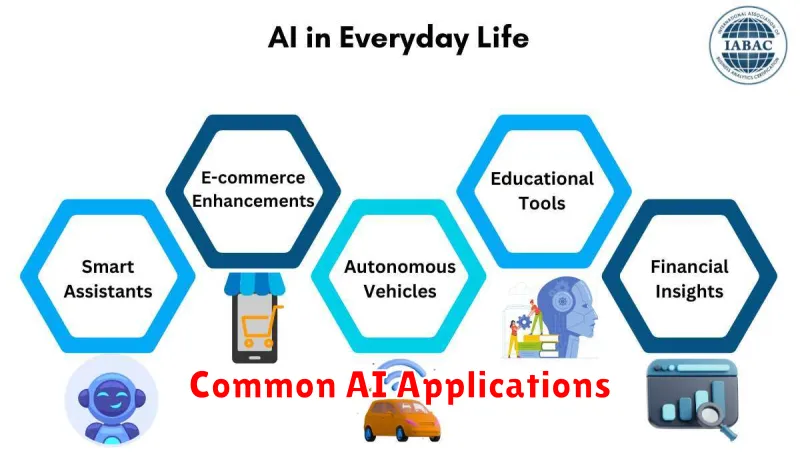
Artificial intelligence is rapidly transforming numerous industries. Understanding common AI applications is crucial for grasping its potential impact.
Machine learning, a subset of AI, powers many applications we interact with daily. This includes personalized recommendations on streaming platforms and online stores. Spam filters utilize machine learning algorithms to identify and remove unwanted emails. Fraud detection systems leverage AI to flag suspicious transactions, protecting consumers and businesses.
Natural language processing (NLP) enables machines to understand and interact with human language. This technology underlies chatbots providing customer service and virtual assistants like Siri and Alexa. NLP also plays a vital role in language translation services.
Computer vision allows computers to “see” and interpret images and videos. This technology is crucial for self-driving cars, enabling them to navigate their surroundings. It is also used in medical imaging for diagnosing diseases and in facial recognition systems.
Learning AI Programming Basics
Embarking on your AI journey starts with grasping the fundamental programming concepts. Python is the dominant language in AI development due to its extensive libraries and frameworks.
Familiarize yourself with core programming elements like variables, data types (integers, floats, strings, booleans), operators (arithmetic, logical, comparison), control flow (if-else statements, loops), and data structures (lists, dictionaries, tuples). These building blocks are essential for writing AI algorithms.
Next, explore key libraries. NumPy provides powerful numerical computation tools, while Pandas simplifies data manipulation and analysis. Matplotlib and Seaborn are vital for data visualization. Understanding these libraries lays the groundwork for more advanced AI concepts.
Ethical Considerations in AI
Developing and deploying AI systems necessitates careful consideration of ethical implications. Bias in data can lead to discriminatory outcomes, reinforcing societal inequalities. AI models must be trained on diverse and representative datasets to mitigate this risk.
Transparency is crucial for building trust and understanding. Users should have insight into how AI systems make decisions, enabling them to identify potential biases or errors. Explainable AI (XAI) techniques aim to achieve this transparency.
Privacy concerns arise from the vast amounts of data required to train and operate AI systems. Safeguarding sensitive information is paramount, and data anonymization and encryption techniques should be employed. Regulations like GDPR play a vital role in protecting individual privacy.
Accountability is another key ethical dimension. When AI systems make mistakes, it’s essential to have clear lines of responsibility. Determining liability in cases involving autonomous systems requires careful consideration.
How to Start a Career in AI
A career in Artificial Intelligence offers diverse paths. You could specialize in areas like Machine Learning, Natural Language Processing, or Computer Vision. Choosing a specialization will help focus your learning and career goals.
Building a strong foundation in mathematics, particularly linear algebra, calculus, and statistics is crucial. Equally important is a solid understanding of programming languages such as Python or R.
Gaining practical experience is essential. Consider working on personal projects, contributing to open-source projects, or pursuing internships to develop your skills and build a portfolio.
Formal education can significantly enhance your career prospects. A Bachelor’s degree in Computer Science or a related field is typically a starting point. Pursuing a Master’s or Doctoral degree in AI or a specialized area can further deepen your knowledge and open doors to advanced research and development roles.
